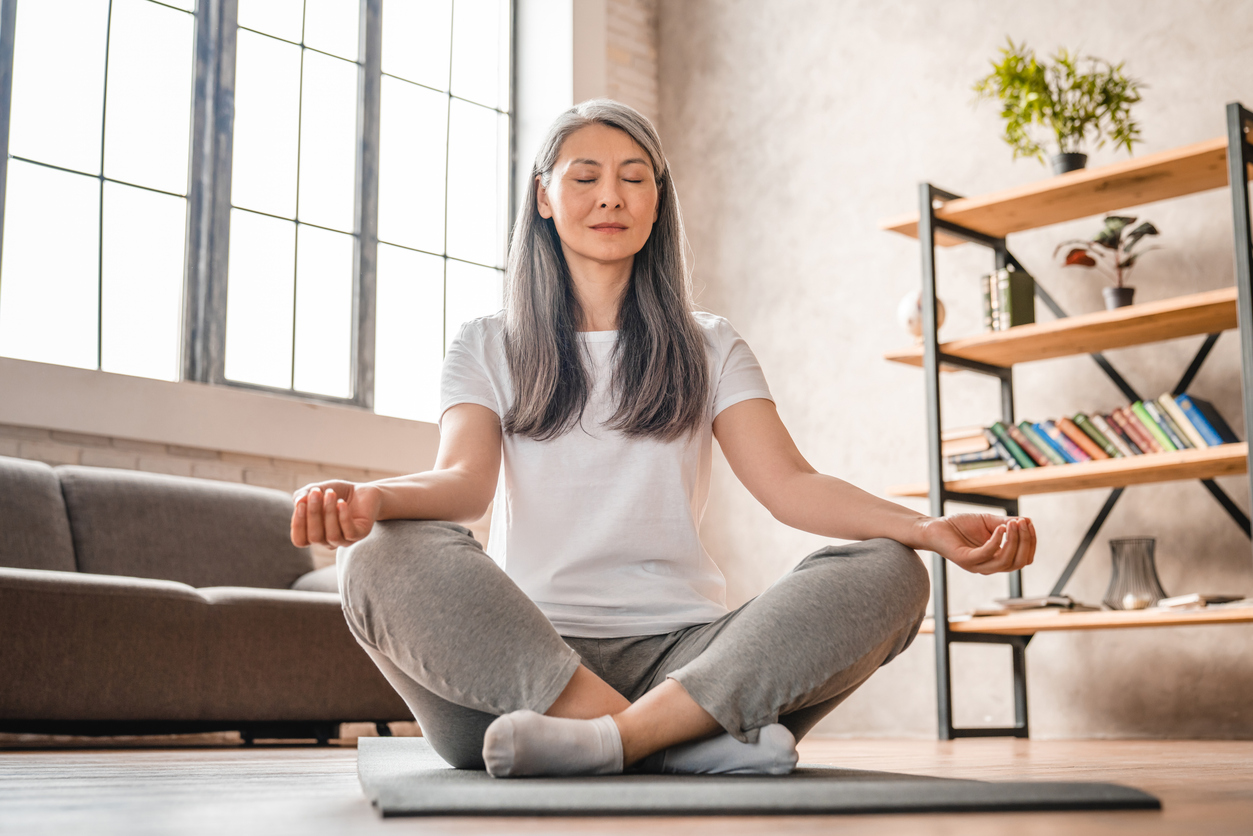
Meditation: Relaxation brings strength
Meditation is a powerful practice that can help you cope better with the challenges of everyday life and gain a deeper understanding of yourself. Here’s what you need to know about meditation.
How does meditation work?
Meditation is a practice that allows us to calm our minds and establish a deeper connection with ourselves. Although there are different types of meditation, they all have common features and principles.
The core of meditation is focussing our mind and consciously directing our attention. This can be achieved using various techniques, such as observing the breath, repeating a mantra, or focussing on a particular object or visualisation.
By focussing our minds on a single thing, we allow ourselves to calm the flood of thoughts and mental distractions. However, meditation does not aim to empty the mind completely, but to calm it and allow it to clear itself.
As we meditate, we often become aware that many thoughts pop up. The key, however, is not to evaluate these thoughts or to pursue them. Instead, we see them as passing clouds without holding on to them. Letting go of thoughts in this way helps us to calm the mind and free ourselves from the endless flow of mental activity.
Another important aspect of meditation is to focus on the present moment. Instead of brooding about the past or worrying about the future, we consciously focus on the present moment. This mindfulness allows us to perceive reality more clearly and distance ourselves from the constant streams of thoughts.
By practising meditation, we also experience relaxation and relief. Deep breathing, a conscious posture and relaxing the muscles help us to relieve stress and achieve profound peace. In this state of relaxation, physical tension and pain can also be released.
In addition, regular meditation allows us to broaden our awareness. We become increasingly aware of our thoughts, emotions and how our mind works. This increased awareness allows us to recognise our thought patterns, break down negative habits and develop greater clarity and self-understanding.
Meditation is a practice that requires time, patience and dedication. Results may vary from person to person, but those who meditate regularly often report improved mental clarity, emotional stability, reduced stress and an increased sense of well-being.
What does meditation do?
Meditation has various effects, ranging from physical to emotional and mental benefits. Studies have shown that meditation can reduce stress, improve concentration and boost overall well-being.
It can also help to relieve anxiety and depression, strengthen the immune system and promote self-confidence. Your relationships with other people often also benefit, as compassion and empathy can increase.
Meditation can also unlock deep spiritual experiences, but this usually requires a certain degree of training and practice.
How does meditation help?
Meditation can help with a variety of challenges and problems. It is particularly useful for relieving stress and dealing with anxiety. People who meditate regularly report an increased ability to deal with difficult emotions and find inner peace.
The practice can also help with sleep disorders, pain management and dealing with addiction. In addition, meditation can help to increase creativity and focus, improve memory, and promote general mental health.
What types of meditation are there?
- Focus on a specific point, such as the breath, a mantra or a visual object
- The aim is to calm the mind by focussing it on a single point
- Popular practices include observing breath, counting breaths or repeating a mantra
- Observation of the present moment without evaluation or judgement
- Focus on sensory perceptions, thoughts and emotions
- The aim is to develop awareness and acceptance of the present moment
- Exercises include body scan, walking meditation or mindful eating
- Develop loving and compassionate thoughts towards yourself and others
- Recite loving wishes or phrases such as “May I be happy; may my compassion benefit all living beings”
- The aim is to open the heart, cultivate compassion and strengthen relationships
- Repetition of a personal mantra, usually provided by the teacher
- The aim is to put the mind into a state of deep relaxation and calm
- Widespread method based on Indian tradition and popularised by Maharishi Mahesh Yogi
- Mindful observation of your own thoughts, emotions and bodily sensations
- The aim is to gain insight and clarity about the nature of the mind and reality
- Traditionally rooted in Buddhist practice
- Achtsame Beobachtung der eigenen Gedanken, Emotionen und Körperempfindungen
- Ziel ist es, Einsicht und Klarheit über die Natur des Geistes und der Realität zu erlangen
- Traditionell in der buddhistischen Praxis verwurzelt
- Emphasis on sitting meditation (zazen) and awakening in the present moment
- Observation of breath and thoughts without attachment or rejection
- Focus on the experience of emptiness and non-thinking
It is important to note that this is only a selection of the many forms of meditation that exist. Each type of meditation has its own unique benefits and can be customised to suit your needs and preferences.
How does meditation change the brain?
Modern neuroscientific studies have shown that meditation can actually result in physiological changes in the brain. Regular meditation leads to increased activity in the areas of the brain associated with positive emotions, compassion and concentration.
The amygdala, which is responsible for the processing of anxiety and stress, shows reduced reactivity in people who meditate. In addition, the prefrontal cortex, which is associated with decision-making and self-control, is strengthened.
These neurological changes help to improve emotional well-being, self-regulation and mental clarity.
